
Centrifugal fan impellor vibration analysis
Investigating vibrations in a centrifugal fan impellor
A heavy manufacturing facility was experiencing vibration in a centrifugal fan following maintenance repairs.
The asset-management and operations teams had extensive knowledge of the fan’s operating regime and history, but they did not have the specialist software or engineering-analysis capability required to assess the impact of operational speeds on vibrational modes.
To best operate the fan and minimise vibration, the team needed evidence about the conditions under which vibration was most likely to occur.
Client: Heavy manufacturing facility
Equipment: Centrifugal fan
Vibration increases the risk of higher bearing loads, fatigue failure and unplanned shutdowns
Vibrating plant is more than a nuisance. An unexpected outage caused by fatigue failure impacts production, maintenance planning and overall confidence in the asset.
The key stage gate was determining whether the fan could continue operating across its normal speed range or whether certain operating conditions should be avoided.
Using modal FEA to identify vibration-risk operating ranges
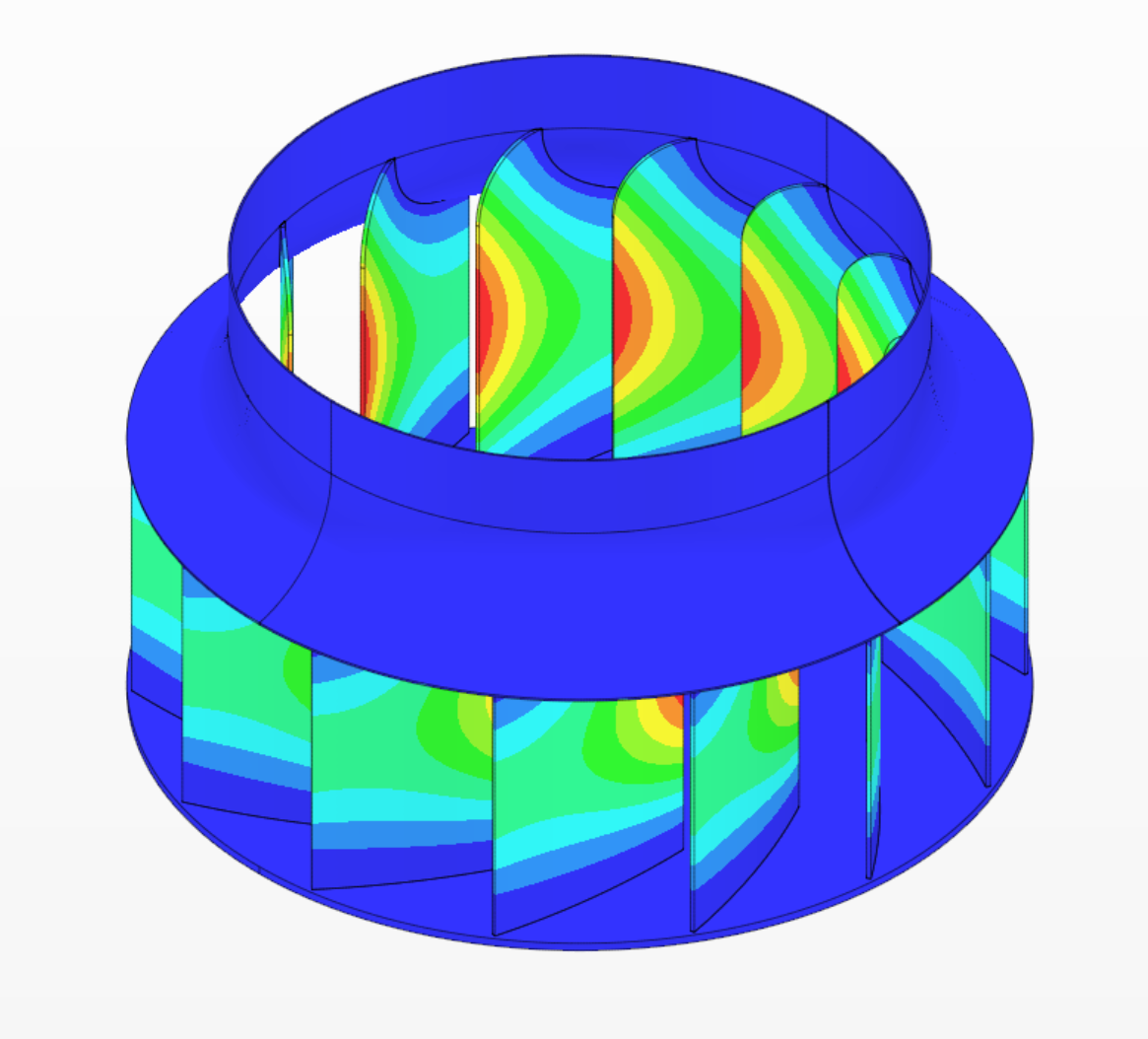
I developed a finite element model representing the fan impeller, bearing housing and mounting block.
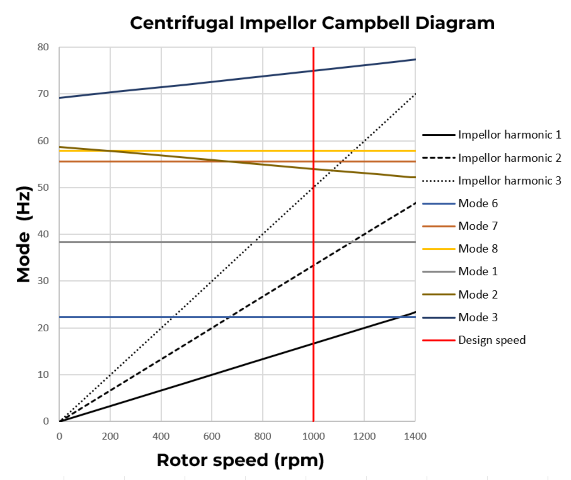
I then performed modal analysis to calculate the natural frequencies and corresponding mode shapes of the structure. Natural frequencies alone are only part of the equation; I therefore mapped the calculated modes against speed-dependent excitation frequencies, including fan rotational frequency, blade-passing frequency and excitation from other supporting components.
A Campbell diagram was produced across an operating range of 400 to 1,200 rpm. This showed where the excitation frequencies approached or intersected the structural natural frequencies and where elevated vibration risk could occur.
The analysis was informed by measured vibration data produced by the client, an important step for any FEA practitioner.
Clearer operating limits to support asset availability
The Campbell diagram converted the FEA results into information the asset-management team could use when considering how the fan should be operated.
The analysis identified specific speed ranges where excitation was more likely to interact with the structure. The client was able to use the findings to avoid operating ranges that could reduce fatigue life.
The key benefit was a clearer basis for operating and managing a critical industrial asset, especially when asset managers, plant operators and managers need evidence to develop a shared understanding of an asset’s performance window.
For heavy industry with highly specialised equipment, not every engineering analysis can be performed in-house. Modal and vibration analysis by an external expert can turn operating concerns raised by asset managers into a useful asset-management decision.
Confidentiality notice: Client and project details have been anonymised to protect confidentiality. Images are representative engineering visualisations and do not disclose client-owned geometry, data or commercial IP.