
Injection moulded stormwater tank system
Verifying the performance of a stormwater tank system prior to tooling
The client had developed an injection-moulded polypropylene stormwater tank product for construction and civil infrastructure applications.
The business had strong manufacturing and injection moulding knowledge, but limited in-house capability to verify whether the product’s ribbed plastic structure would withstand the required loading during transport and in-service use.
Before moving forward, the team needed confidence that the design would withstand the loads specified in the industry code CIRIA C737. Without meeting the requirements of this code, there would be no prospect of sales or installation on site.
Client: Plastic injection moulding manufacturer
Product: injection-moulded polypropylene stormwater tank system
Injection moulds as a major CAPEX investment
The new product required tooling that would be a major strategic CAPEX investment.
Once the mould was cut, any weakness embedded in the geometry would become expensive to correct. The potential consequences included mould modification, redesign, delayed production and the risk of manufacturing parts that did not meet the required performance.
The question of whether the product would pass CIRIA C737 would be a key stage gate to help the company decide whether it should commit significant capital to tooling.
Engineering analysis and FEA to determine performance
Every new analysis of a product or design must start with first-principles engineering instead of jumping straight into expensive FEA software. I examined the expected load paths and simplified the structure into a cylindrical, column-like form to establish a physical understanding of the structure and provide an independent check for the simulation.
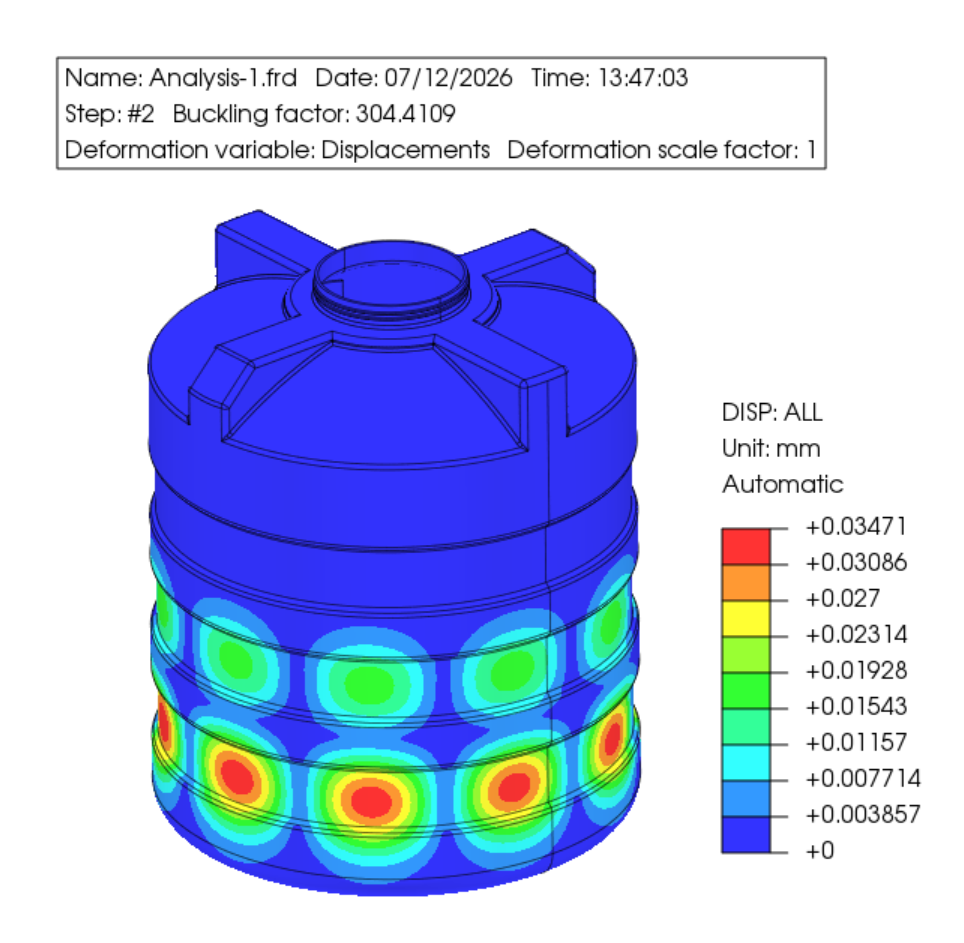
I then developed a full finite element model to assess the complete product under the required compression loading and compare its behaviour with the relevant performance requirements. The analysis included compression loading and buckling.
Modelling plastics such as polypropylene is much more complex than modelling classic engineering materials such as steel or aluminium, as they behave very differently. I undertook benchmarking of published literature on the performance of polypropylene—an important and necessary step for any FEA operator.
Modifications could be made before expensive moulding
Through close collaboration and communication with the company’s manufacturing and operations personnel, several design issues were identified prior to tooling. This meant the geometry could still be refined in CAD rather than corrected through expensive mould changes or production workarounds.
Using calculations before FEA also prevented the project from becoming a software exercise. The client gained a clearer understanding of how the product carried load and which features governed its structural performance, enabling product changes to be made.
Stage-gating a project to capture enough evidence that the product meets the industry standard and can enable customer sales is a smart way of approaching injection mould tooling manufacture.
The client was able to obtain clear evidence about where refinement was required before making the tooling commitment.
Product design iterations to enable a successful market launch
The key benefit was the stage-gated ability to improve the product while change was still comparatively inexpensive. This would enable the product to meet industry standards, meaning it could be launched into the market.
For any manufacturer approaching a major tooling decision, discovering a problem before manufacture is not a “failed project”; it is the highest-value outcome engineering analysis can deliver.
Confidentiality notice: Client and project details have been anonymised to protect confidentiality. Images are representative engineering visualisations and do not disclose client-owned geometry, data or commercial IP.